India GST – Congress Dissent Points
Stand of Congress Party – is it Genuine Dissent or Politics
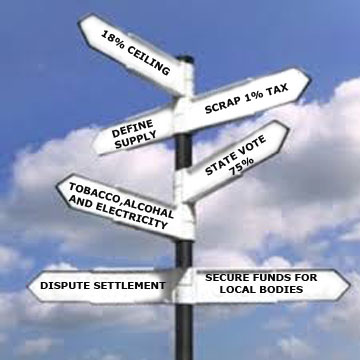
GST was initiated by the UPA Government in Budget 2006-07 and the 115th Constitution Amendment Bill, 2011 was introduced by Congress led UPA. Surprisingly some of the dissenting points were not part of the 2011 Bill piloted by the Congress, leaving one to wonder if the dissent note is just politics.
The issues of the dissent note to the Select Committee submitted by the Congress party are
|
1. |
Ceiling of GST rate @ 18%. |
|
2. |
Scrap 1% Additional Tax. |
|
3. |
Define “Supply/ies”. |
|
4. |
Tobacco and tobacco products, alcohol for human consumption and electricity supply should be included with a condition of being included by the council within 5 years. |
|
5. |
Voting share of States to be increased to 75%. |
|
6. |
Setting up of GST Dispute Settlement Authority |
|
7. |
Sources of revenue of the Panchayats and Municipalities to be safeguarded. |
|
8. |
Special consideration by the council towards States and Union Territory who’s population does not exceed 20 lakh. |
From the consumer and business perspective, what is materially different in the Constitution (122nd) Amendment Bill, 2014 from the 115th Constitution Amendment Bill, 2011 is the 1% Additional Tax.
The 1% additional tax is definitely a distortion as also pointed out by several experts. The Government should reconsider this additional levy which is stated to be initially for 2 years. In the context of the compensation of revenue loss to States for the initial 5 years, all revenue loss including that the 1% Additional Tax that is intended to recoup loss of revenue, would be factored in the compensation promised and therefore the 1% additional tax should be dropped.
The demand for specifying the combined rate of CGST and SGST at 18% in the Constitution Amendment Bill appears to be without rationale. The rate of tax is a function of different variables like buoyancy of the economy and consequent revenue collection, nature of goods like demerit goods warranting a higher rate of tax, political and economic priorities etc. It is best left to the wisdom of the GST Council to decide the rate of tax. Hard coding (in IT terminology) the rate of tax is not desirable as the flexibility to decide the rate of tax is lost.
While inclusion of Tobacco and tobacco products, alcohol for human consumption and electricity supply is definitely desirable and necessary, it would be good if these goods are also left to the discretion of the GST Council to decide on inclusion under GST at a later point of time.
It is to be appreciated that there is no perfect GST and implementation of any major tax reform is more of a political compromise than economics.
While die hard proponents of an ideal GST would elaborate on serious imperfections, the issue is do we wait for an ideal GST and give up the opportunity to implement the proposed design of GST that seems to have broad consensus.
GST implementation efforts have never been closer to implementation than at present and it appears that it is best to go ahead with the proposed design of GST than risk the possibility of indefinite postponement.
Well, the present design may not be ideal, and for those who are skeptical, it is hoped that they would appreciate it would be far better than the present system of taxation sans the 1% levy and permanent exclusion of Tobacco and tobacco products, alcohol for human consumption and electricity supply.
Date : 3rd August, 2015.